

Inlays and onlays are highly effective dental restorations for repairing damaged teeth without the need for a full crown. Used primarily on posterior teeth, these devices restore tooth form and function while preserving much of the natural structure. Find out why and how to opt for inlays and onlays as part of your treatment at the Claude Monet dental practice in Croissy-sur-Seine.
When should you choose an inlay or an onlay?
This treatment option should be considered when the tooth is too damaged for a simple composite, but a crown is not necessary. These devices can be used to fill a cavity or reinforce the chewing surface.
Unlike traditional “fillings”, inlays and onlays are made in the laboratory to adapt perfectly to the shape of your tooth and guarantee a long-term seal, keeping your tooth in place.
The difference between an inlay and an onlay
Inlays and onlays are customized dental solutions used to restore a tooth damaged by severe decay or dental fracture. The main difference lies in the extent of the restoration:
- Inlay is used when the damaged part is limited to the inside of the tooth, without covering its edges.
- Onlay is used when damage is more extensive and requires covering one or more cusps (the tips) of the tooth.
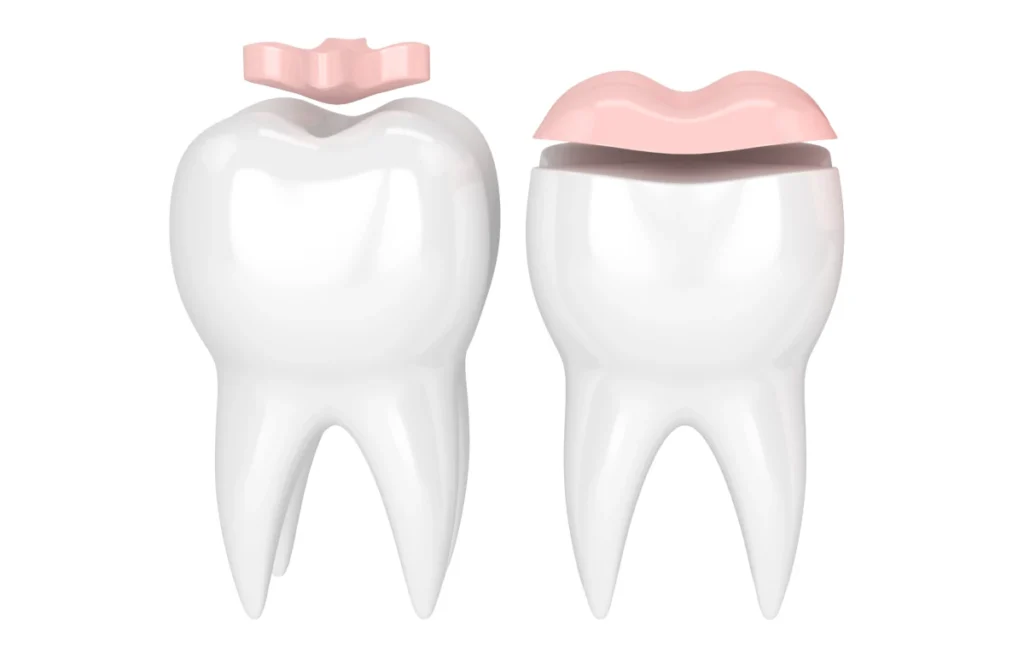
They are installed as a sort of “puzzle piece” that fills in the affected area.
The advantages of inlays and onlays
- Preserving tooth structure
Unlike crowns, inlays and onlays preserve an important part of your natural tooth. This conservative approach ensures that the tooth retains its strength and integrity. As a result, your restored teeth remain functional longer. By choosing this option, you avoid a more invasive solution.
- Resistance and durability
The materials used for inlays and onlays, such as ceramic, perfectly withstand the pressure exerted during chewing. This ensures a durable restoration that can withstand years of daily use. What’s more, they don’t deteriorate as quickly as metal amalgams or composite resins made directly in the mouth for smaller reconstructions.
- Improved aesthetics
Inlays and onlays are designed to blend perfectly with the color of your teeth. This means that, once placed, they are virtually invisible. You benefit from a discreet, aesthetic solution. The natural appearance of your teeth is preserved, contributing to a harmonious smile.
How are inlays and onlays treated?
First step: Preparing the tooth
The first step is to prepare the tooth by removing the decayed or damaged part in a minimally invasive way. This step is painless and is performed under local anaesthetic to ensure your comfort.
A digital impression is then taken, ensuring extreme precision for the fabrication of restorations. The intra-oral scanner eliminates the discomfort of traditional impressions, while increasing the speed and accuracy of measurements. This impression is sent to a dental laboratory, where qualified technicians fabricate your custom ceramic inlay or onlay. Until the final restoration is placed, a temporary restoration is placed on the tooth.
Second step: placing the inlay or onlay
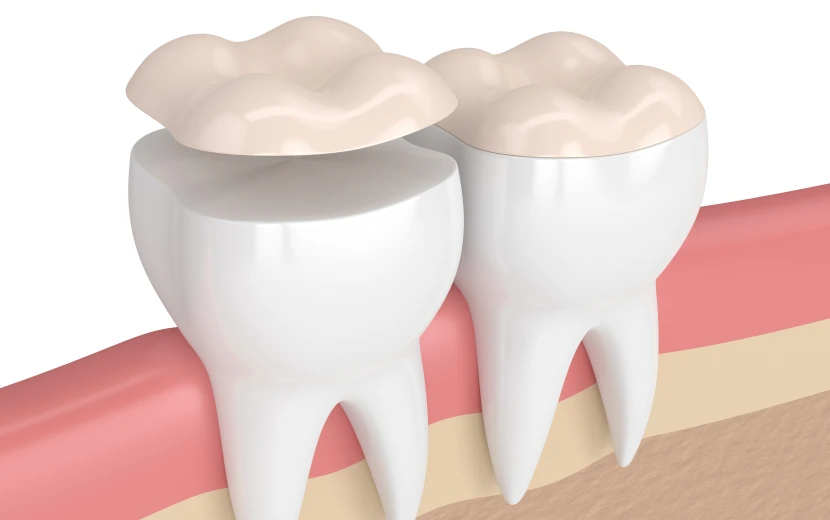
During this second visit, your dentist first checks that your inlay or onlay fits your teeth perfectly. If any adjustments are necessary, these are made before the final fitting. Next, the dentist cleans your teeth, then applies a special adhesive. A UV light is used to harden the glue quickly, ensuring perfect adhesion. Finally, the dentist makes final adjustments to ensure your comfort and optimize aesthetics.
Placement is painless, often using light anesthetic techniques to ensure maximum comfort. Once the restoration is in place, you’re left with a functional and aesthetically pleasing tooth.
Care for your inlays and onlays
- Daily oral hygiene
Careful brushing twice a day and the use of interdental brushes or dental floss are essential to prevent plaque build-up around the inlay or onlay. Although these restorations are highly resistant, good hygiene prevents cavities and gingival inflammation.
- Regular dental check-ups
It’s essential to continue visiting your dentist regularly to check the condition of your restorations. These checks can detect any problems before they become serious. What’s more, professional scaling helps extend the life of your inlays and onlays.
- Food precautions
Although inlays and onlays are very strong, it is advisable to avoid biting into particularly hard foods such as ice cubes or nuts. These actions can weaken or even damage the restoration. In addition, avoid very sweet foods and drinks, which increase the risk of cavities.
Why choose the Claude Monet dental practice in Croissy-sur-Seine?
At the Claude Monet dental practice in Croissy-sur-Seine, our team of dentists is committed to providing quality care tailored to your needs. By opting for inlays and onlays, you benefit from personalized service, and your smile is preserved. Our dentists use reliable, aesthetic materials to ensure your comfort and the durability of your restorations.
- Care tailored to each patient
Every patient is unique, and the solutions offered at Claude Monet take this individuality into account. After a thorough examination, the dentist will suggest the option best suited to your tooth structure and aesthetic preferences. Whether it’s an inlay or an onlay, treatment is meticulous and personalized.
- A modern, comfortable environment
The practice is equipped with the latest technology to ensure precise, effective care. What’s more, patient comfort is a priority. You’ll be welcomed into a warm and soothing environment, ideal for reducing any treatment-related anxiety.
- Safety first
Safety and hygiene are paramount at the Claude Monet dental practice. All procedures are carried out in compliance with strict hygiene standards. You can rest assured that your health is in good hands.
care for your smile with inlays and onlays
Inlays and onlays are the ideal solution for restoring your teeth in a durable and aesthetic way. At the Claude Monet dental practice in Croissy-sur-Seine, you’ll benefit from tailor-made treatment that combines comfort and effectiveness.
Don’t wait any longer to make an appointment and discover how these restorations can help you regain a healthy, harmonious smile.
Frequently asked questions
Quelle est la durée de vie d’un inlay ou d’un onlay ?
The lifespan of inlays and onlays depends on a number of factors, such as daily maintenance and eating habits. In general, they can last between 10 and 15 years, or even longer with proper care. The materials used, such as ceramic or resin, are highly resistant and guarantee long durability.
Les inlay et onlays sont-ils douloureux à poser ?
An inlay or onlay is placed under local anaesthetic, so you won’t feel any pain during the procedure. After the procedure, you may feel a slight sensitivity, but this quickly disappears. If you follow your dentist’s recommendations, recovery is usually rapid and uncomplicated.
Quel est le coût d’un inlay ou d’un onlay ?
The price of an inlay or onlay varies according to the material chosen and the complexity of the case. During your consultation at the Claude Monet dental office, you will be given a personalized quote. This estimate will take into account your specific needs and situation.
Quelle est la différence entre un plombage et un inlay/onlay ?
Fillings are used to repair small cavities in teeth, while inlays or onlays are recommended for larger restorations. Unlike fillings, these restorations are custom-made and more durable. What’s more, they are more aesthetically pleasing, as they blend in perfectly with the tooth.
Peut-on avoir des allergies aux matériaux des inlay et onlays ?
The materials used for inlays and onlays, such as ceramic or composite resin, are generally well tolerated and metal-free. However, if you have any known allergies, it’s important to tell your dentist before treatment. At the Claude Monet dental practice, every precaution is taken to avoid allergic reactions.