
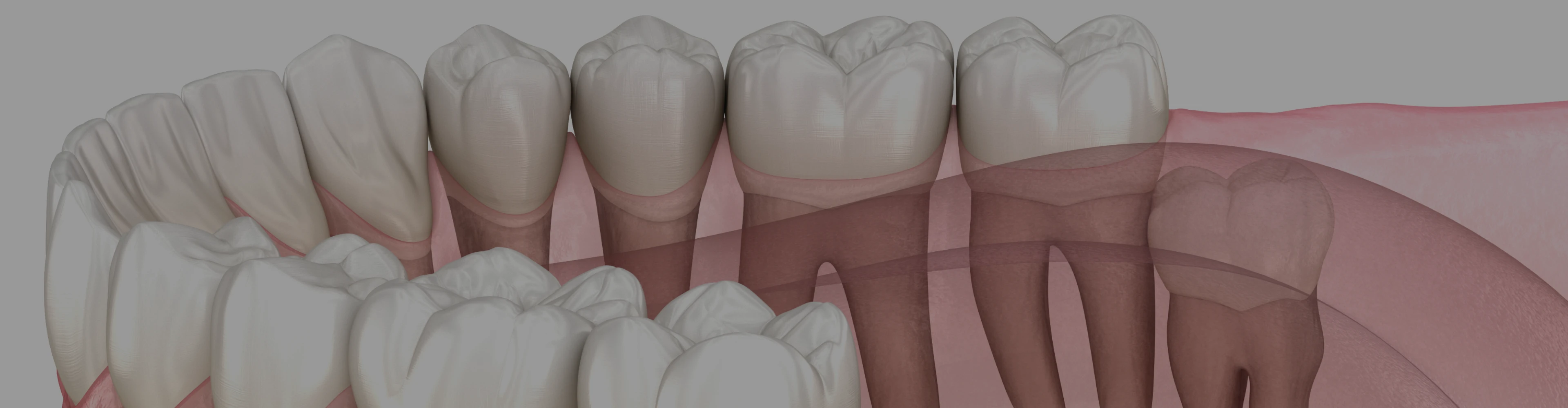
Major improvements in dentistry now make wisdom tooth extraction gentle, comfortable and easy for the patient.
Should I have my wisdom teeth removed?
Wisdom teeth extraction involves removing the upper and/or lower third molars. In children and adolescents, these teeth have not completed their development and are called germs (the procedure is called “germectomy”).
Wisdom teeth are often removed for one or more of the following reasons:
- Persistent and/or recurrent pain and/or infection
- Caries damage
- Damage to adjacent teeth
- Damage to surrounding tissue (swollen gums, biting/traumatized cheeks, bone lesions)
- Difficulty in cleaning due to their position and/or orientation in the mouth
- Lack of space at the back of the mouth to allow straight eruption: risk of disturbing the proper alignment of teeth in children and adolescents (often indicated by the orthodontist).
X-rays and a clinical examination are the best way to determine whether your wisdom teeth need to be removed. If you are also undergoing orthodontic treatment, the decision will be made jointly with your orthodontist. During the consultation, you can discuss the benefits and possible risks of this procedure.
It’s often best to be proactive and remove wisdom teeth before any problems arise, if a negative evolution is to be feared.
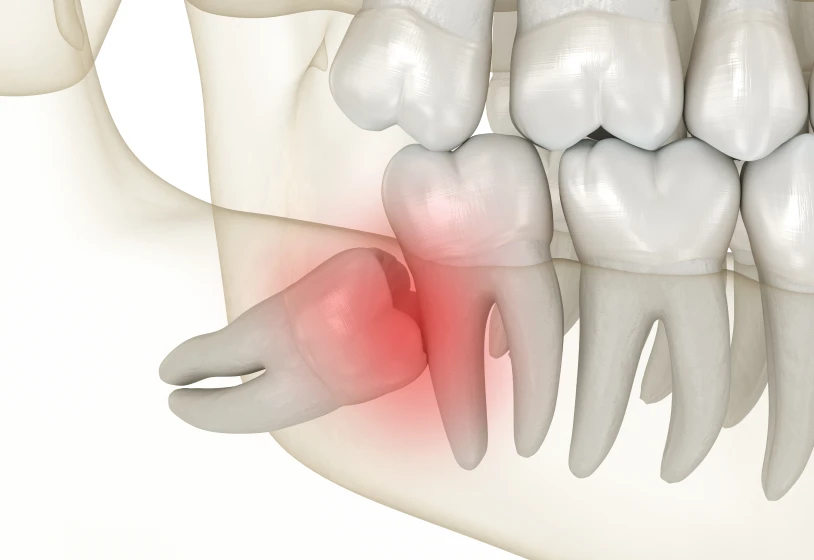
If your wisdom teeth are not removed, it will still be necessary to monitor them periodically to make sure they are not affecting the health of your other teeth.
While it’s best to remove wisdom teeth before their roots are fully developed, they can also be safely removed later in adulthood.
Wisdom teeth extraction at the Claude Monet practice
Wisdom teeth extraction is a procedure we perform daily at the Claude Monet practice. It is performed under local anesthetic to ensure your comfort throughout the procedure.
We use 2D (panoramic) and 3D (CBCT) radiography to safely remove wisdom teeth. Cone-beam or CBCT technology gives us a perfect understanding of the wisdom tooth’s environment and its relationship to the jaw nerve.
After the procedure, you may experience some swelling and slight pain, which will be very well managed with ice applications and the necessary medication. You will receive post-operative instructions tailored to your situation.
In certain situations (anatomical peculiarities, small mouth opening, anxiety or patient request), inpatient treatment under general anaesthetic may be recommended.
Have you ever wondered why the last four teeth to grow in are called wisdom teeth? It’s because they don’t usually come in until our late teens or early twenties; by then, we’re supposed to be wiser!